
Ileosigmoid Knotting (ISK)
Ileosigmoid Knotting (ISK)
Andrew M. Holloway, MD and Michael T. Langford, MD
Table of Contents
Definition and Classification
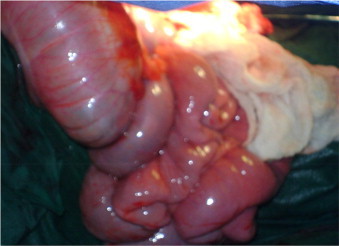
Ileosigmoid Knotting (ISK): Axial Twisting of the Ileum and Sigmoid Colon Around Each Other
Considered a “Compound” or “Double Volvulus” as Both Segments Twist Around Each Other (Knotted) Causing Closed Loop Obstruction of Both the Small and Large Intestine
Causes a Closed Loop Obstruction That Can Cause Vascular Compromise with Ischemia, Necrosis, and Perforation
Rare Phenomenon
Classification
- Type I: The Ileum (Active Component) Encircles the Sigmoid (Passive Component) – Most Common
- iA: Clockwise Rotation
- IB: Counterclockwise Rotation
- Type II: The Sigmoid (Active Component) Encircles the Ileum (Passive Component)
- IIA: Clockwise Rotation
- IIB: Counterclockwise Rotation
- Type III: Ileum and Cecum (Active Component) Encircles the Sigmoid (Passive Component) – Most Rare
Ileosigmoid Knot 1
Etiology
Rare in the West but More Common in Africa, Asia, and the Middle East
Predisposed by the Coexistence of a Redundant Sigmoid Colon and a Long, Mobile Small Bowel Mesentery
Risk Factors
- Male Sex
- Chronic Constipation
- High-Fiber Diet
- Adhesions
- Pregnancy
More Common in Middle-Aged Adults, Younger than in Sigmoid Volvulus
Presentation and Diagnosis
Presentation
- Abdominal Pain
- Abdominal Distention
- Nausea and Vomiting
- Obstipation
Causes Rapid Ischemia and Necrosis Earlier than Isolated Sigmoid Volvulus with Higher Mortality (Up to 73%)
Diagnosis
- Generally Diagnosed by CT Abdomen/Pelvis
- Ileum and Sigmoid Colon are Dilated and Twisted Around Each Other
- “Whirl Sign” with Mesentery Twisted
- Abdominal Plain Film is Generally Nondiagnostic
Often Presents with an Acute Abdomen and is Diagnosed at Surgical Exploration in an Emergent Setting
Management
The Primary Treatment is Surgical Resection (Requires Resection of Both Segments)
Endoscopic Detorsion Not Recommended
References
- Igwe PO, Jebbin NJ, Dodiyi-Manuel A, Adotey JM. Ileosigmoid knotting in patients under 25 years of age: A report of two cases. Int J Surg Case Rep. 2014;5(11):824-8. (Liscence: CC BY-NC-ND-3.0)