
McVay Repair
McVay Repair
David Ray Velez, MD
Definition
Also Known as the “Cooper’s Ligament Repair”
Definition: An Open Tissue Repair that Reconstructs the Posterior Wall by Approximation of the Conjoined Tendon to the Cooper’s Ligament
Repairs Both Inguinal Hernias and Femoral Hernias – Historically the Preferred Method for Femoral Hernia Repair Prior to the Widespread Adoption of Mesh Repairs
See Also:
*See Inguinal Hernia
*See Femoral Hernia
*See Inguinal Hernia Repair (IHR)
Technique
Skin Incision: 6-8 cm Oblique Incision Parallel and Just Superior to the Inguinal Ligament
Dissection
- Carry Incision Down Through the Subcutaneous Tissue and Scarpa’s Fascia
- Expose and Longitudinally Incise the External Oblique Aponeurosis to Enter the Inguinal Canal
- Preserve the Ilioinguinal Nerve
- Mobilize and Isolate the Spermatic Cord and Encircle it with a Penrose Drain
- Dissect the Hernia Sac from the Spermatic Cord and Reduce It
- Consider High Ligation and Resection of the Sac vs Reduction Alone
- Incise the Posterior Wall (Transversalis Fascia) from the Internal Ring to the Pubic Tubercle to Expose the Preperitoneal Space and Facilitate Reduction of the Hernia Sac
- Develop the Preperitoneal Plane to Expose Cooper’s Ligament Along the Superior Pubic Ramus
Repair
- Approximate the Conjoined Tendon (Internal Oblique and Transversus Abdominis Aponeurosis) to Cooper’s Ligament
- Classically Uses Interrupted Nonabsorbable Sutures
- Begins Medially at the Pubic Tubercle
- Continue Laterally Along Cooper’s Ligament Until It Can No Longer Be Safely Reached
- Place a “Transition Stitch” Incorporating the Conjoined Tendon, Cooper’s Ligament, AND the Shelving Edge of the Inguinal Ligament
- Continue the Lateral Repair by Approximating the Conjoined Tendon to the Shelving Edge of the Inguinal Ligament
- Continue Until the Internal Ring is Recreated Around the Spermatic Cord without Constriction
Caution: Avoid Injury to the Femoral Vein During Lateral Dissection Along Cooper’s Ligament as it Terminates Near the Vein – One of the Classic Reasons for the Transition Stitch
May Create a “Relaxing Incision” of the Anterior Rectus Sheath if Under Perceived Tension
Closure
- Return the Spermatic Cord to the Inguinal Canal
- Close the External Oblique Aponeurosis Over the Spermatic Cord
- Preserve the Ilioinguinal Nerve
- Close Scarpa’s Fascia and Skin
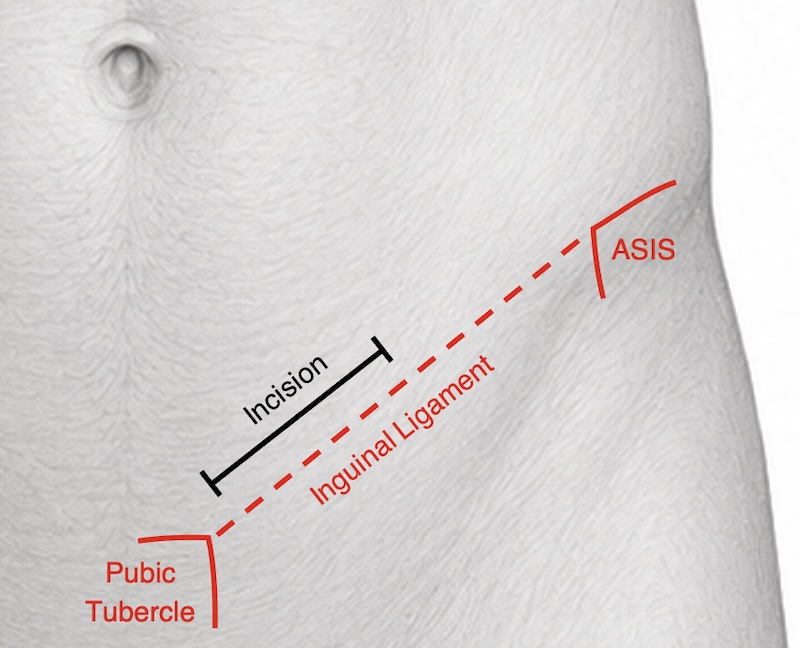
Incision
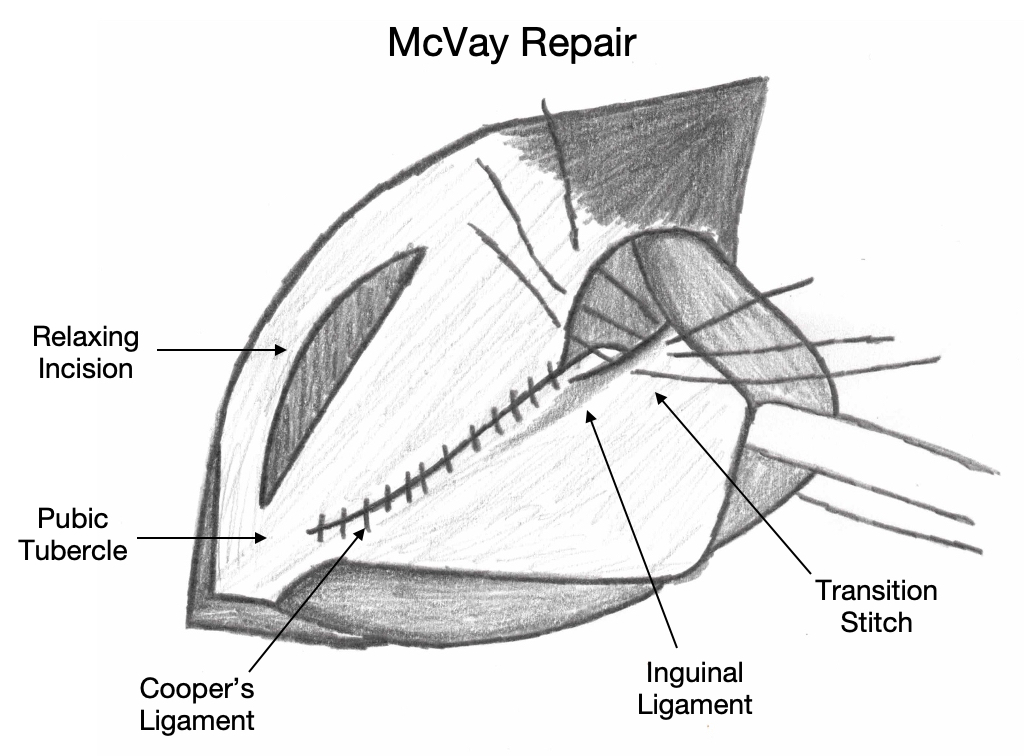
Repair: Conjoined Tendon to Cooper’s Ligament