
EGJOO
Esophagogastric Junction Outflow Obstruction (EGJOO)
Yaiel G. Rodríguez-Avilés, MD
Table of Contents
Definition
Definition: An Esophageal Motility Disorder Characterized by Impaired Relaxation and/or Increased Resistance to Outflow Across the Esophagogastric Junction (EGJ) but with Preserved Peristalsis
Diagnosis Requires Compatible Symptoms and Supportive Testing – A Manometric Diagnosis of EGJOO Alone is Clinically Inconclusive and Does Not, by Itself, Establish Clinically Significant EGJ Obstruction
Pathogenesis and Causes
Pathogenesis
- Represents a Heterogeneous Disease Subgroup with No Single Pathophysiologic Cause
- Functional/Neurogenic LES Dysfunction
- May Represent an Early/Evolving Variant of Achalasia
- Mechanical/Structural Resistance
- Extrinsic Factors Raising Outflow Resistance Despite Otherwise Normal LES Smooth Muscle Function
- Artifactual (False) IRP Elevation
- Equipment Malfunction or Malposition
Causes
- Primary/Functional EGJOO
- Idiopathic
- Early/Evolving Achalasia
- Mechanical/Anatomic
- Hiatal Hernia
- Esophageal Stricture
- Prior Fundoplication
- Prior Bariatric Surgery
- Esophageal Rings/Webs
- Eosinophilic Esophagitis
- Extrinsic Vascular Compression
- Malignant/Infiltrative
- Malignancy Involving the EGJ
- Medication Related
- Opioid-Induced
- Artifactual
- Catheter/Equipment Artifact/Error
- Central Obesity
Clinical Presentation
Clinically Relevant Symptoms
- Dysphagia
- Usually to Solid Foods
- Non-Cardiac Chest Pain
Additional Symptoms
- Regurgitation
- Heartburn (Retrosternal Burning)
- Cough
- Aspiration and Recurrent Pneumonia
Per Chicago Classification v4.0: EGJOO is Clinically Relevant Only When the Manometric Pattern is Accompanied by Dysphagia and/or Non-Cardiac Chest Pain and Supported by Objective Evidence of EGJ Obstruction
Diagnosis
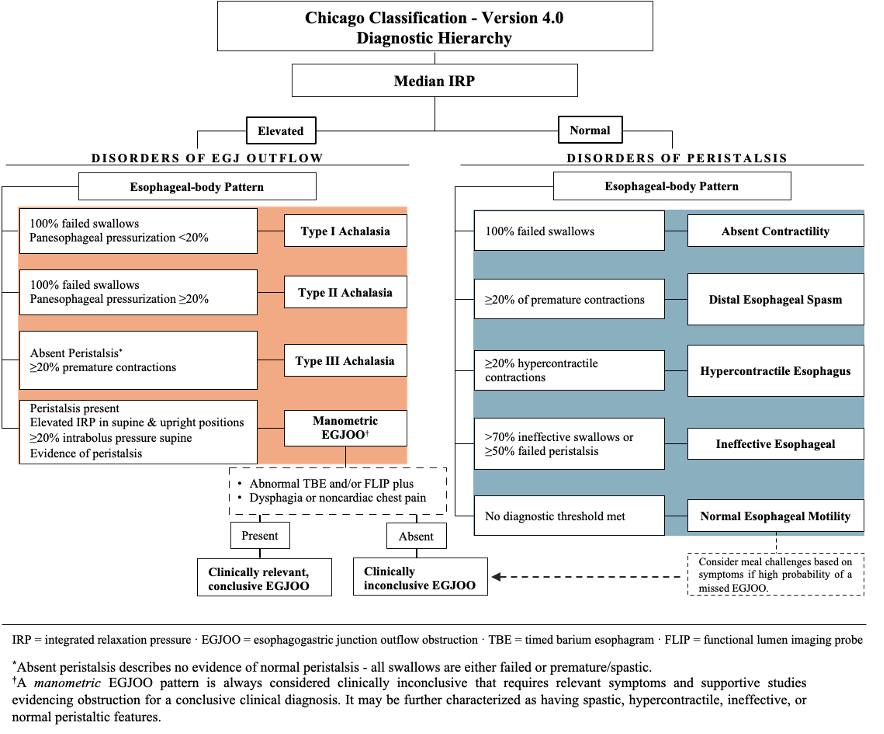
Diagnosis of Clinically Relevant EGJOO Requires 3 Things:
- High-Resolution Manometry Indicating EGJOO
- Clinically Relevant Symptoms (Dysphagia and/or Non-Cardiac Chest Pain)
- Supportive Evidence of Obstruction by Timed Barium Esophagram (TBE) and/or Functional Lumen Imaging Probe (FLIP)
Upper Endoscopy/Esophagogastroduodenoscopy (EGD)
- Should Be Performed in All Patients with Suspected EGJOO
- Often the First Diagnostic Test Performed
- Used to Evaluate for Malignancy or Other Mechanical/Anatomic Cause of Obstruction
High-Resolution Manometry (HRM)
- The Gold Standard Diagnostic Test
- Findings:
- Elevated Median Integrated Relaxation Pressure (IRP) in Both Supine and Upright Position
- Concordant Elevation Required
- Elevated Intrabolus Pressure in ≥ 20% of Supine Swallows
- Preserved Peristalsis
- Does Not Meet Criteria for Achalasia
- Elevated Median Integrated Relaxation Pressure (IRP) in Both Supine and Upright Position
- Provocative Maneuvers Increase Diagnostic Confidence
- Rapid Drink Challenge
- Solid Swallows
- Pharmacologic Provocation
- EGJOO May Coexist with Other Esophageal Motility Disorders:
- Ineffective Motility
- Hypercontractile Features
- Spastic Features
Timed Barium Esophagram (TBE)
- Used to Demonstrate Objective Impairment of Esophageal Emptying Across the EGJ
- Findings Supporting Clinically Relevant EGJOO:
- Delayed Barium Clearance
- Retained Barium Column
- Retention of a Barium Tablet at the EGJ
- Other Findings:
- Evaluate for Hiatal Hernias
- Evaluate for Diverticula
- Identify Other Structural Abnormalities
- Provides a Quantitative Assessment of Esophageal Emptying
Functional Lumen Imaging Probe (FLIP)
- Uses Impedance Planimetry by Balloon Catheter to Measure Cross-Sectional Area and Intra-Luminal Pressure
-
- The Ratio of the Two Measurements at the Level of the EGJ is Called the Distensibility Index (EGJ-DI)
- Reduced EGJ-DI Provides Objective Evidence of EGJ Outflow Obstruction in the Appropriate Clinical Context
- Particularly Useful When:
- HRM Findings are Inconclusive
- TBE Findings are Equivocal
- Additional Objective Evidence of EGJOO is Needed
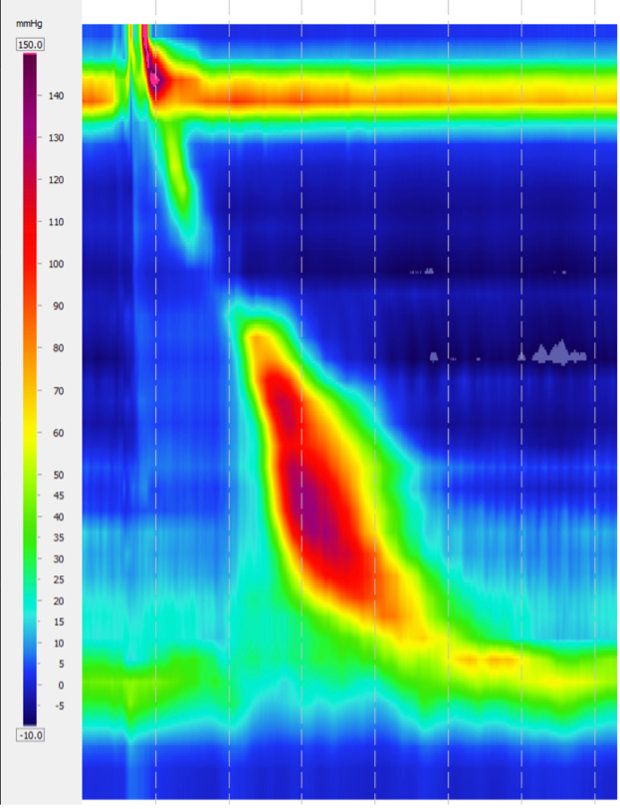
EGJOO Manometry: Normal Propagation of the Contractile Wavefront with Outflow Obstruction at the EGJ
Treatment
General Approach
- Primary EGJOO:
- Observation May Be Appropriate if Symptoms are Mild
- Definitive LES-Directed Therapy is Generally Reserved for Carefully Selected Patients with Convincing Evidence of Primary Functional EGJOO and Persistent, Clinically Significant Symptoms
- Pneumatic Dilation (PD) – Less Invasive and Often the Initial Approach
- Myotomy (Surgical/Heller vs POEM) – More Invasive but Potentially More Durable
- *Use of PD and Myotomy is Less Well Validated than in Achalasia
- Botulinum Toxin Injection for Temporary Symptom Relief if Poor Candidate for Definitive LES-Directed Therapy
- Secondary EGJOO: Treat the Underlying Cause
- Dilation for Strictures, Rings, and Webs
- Repair of Hiatal Hernias
- Oncologic Treatment for Malignancy
- Discontinuation of Opioids for Medication-Induced EGJOO
Heller Myotomy (HM)
- Procedure: Complete Division of Both the Circular and Longitudinal Muscle Fibers of the Distal Esophagus and Proximal Stomach to Fully Disrupt the Non-Relaxing Lower Esophageal Sphincter (LES)
- Preserves the Inner Submucosa and Mucosa
- Myotomy Extent:
- Proximal: 4-6 cm onto the Distal Esophagus
- Distal: 2-3 cm onto the Gastric Cardia
- Usually Combined with a Partial Fundoplication (Dor or Toupet)
- Partial Fundoplication Reduces Postoperative GERD by Controlling Distal Esophageal Acid Exposure
- Complete Nissen Fundoplication is Generally Avoided Because it May Recreate EGJ Obstruction
Peroral Endoscopic Myotomy (POEM)
- Procedure: Endoscopic Submucosal Tunneling Followed by Division of the LES Muscle
- Advantages:
- Can Be Performed After Previous Dilation or Heller Myotomy
- Avoids Abdominal or Thoracic Surgical Access
- Disadvantages:
- No Concomitant Fundoplication
- Higher Risk of Postoperative GERD and Reflux Esophagitis
Pneumatic Dilation (PD)
- Procedure: Endoscopic Dilation of the LES Using a Graded Pneumatic Balloon
- May Require Repeated/Sequential Graded Dilations: 3.0 cm, 3.5 cm, 4.0 cm
- Major Complications:
- Esophageal Perforation
- GERD
Botulinum Toxin Injection (Botox)
- Mechanism: Inhibits Acetylcholine Release at the LES
- Can Provide Short-Term Symptomatic Relief if Poor Candidate for Definitive LES-Directed Therapy
- Effects are Generally Temporary with High Recurrence and Repeated Injections are Often Required